Microsoft's Maia 300 chip aims to cut its reliance on Nvidia GPUs
Microsoft says the third-generation chip will become its main system for AI inference by 2027, promising major efficiency gains over GPU-based servers.
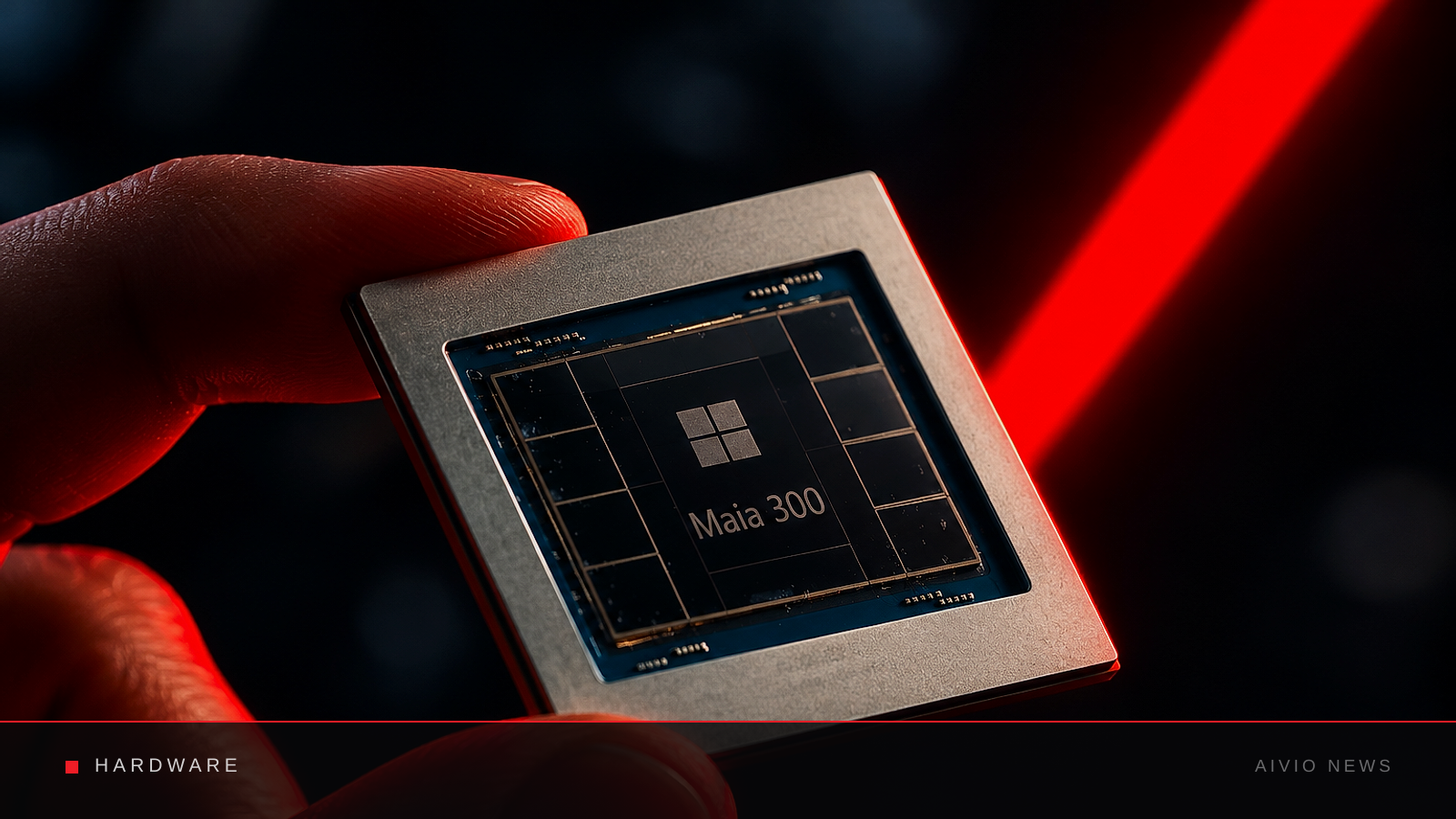
Microsoft announced the Maia 300, the third generation of its in-house AI chip, saying it is designed to become the company’s main system for AI inference, when trained models generate live answers, across Microsoft’s own products and services. The chip will begin rolling out to production AI workloads in 2027, according to the company.
Scott Guthrie, executive vice president of Microsoft’s cloud group, said Maia 300 is built for efficiency. “We expect Maia 300 to deliver 40 percent more tokens per megawatt compared to leading GPU-based systems,” Guthrie said. He added that in a full 96-accelerator configuration, the chip delivers up to seven times the rack-scale token throughput of its predecessor, Maia 200.
Those gains are central to Microsoft’s plan to lean less on outside chipmakers. Guthrie said Microsoft will scale its Azure Maia family to multi-gigawatt deployments starting in 2027, making Maia “the primary AI inference system for Microsoft products and services.” That would reduce the company’s dependence on graphics processing units, or GPUs, from Nvidia and AMD for its own workloads.
Maia 200, announced in January, is already running production workloads including Microsoft Copilot, GitHub Copilot, Microsoft Foundry and Microsoft’s own AI models. Guthrie called it “the best performing AI infrastructure in our fleet, measured in real world metrics for AI services.” Microsoft says Maia 300 goes further, built as what Guthrie described as “a complete AI system” for long-context reasoning, latency-sensitive conversational tasks and sustained, multi-step agentic work, where a model carries out several actions in sequence.
A new chip architecture
Microsoft’s Azure hardware and infrastructure team said the efficiency gains come from a new chiplet design, which joins several smaller specialized dies into one chip, built on TSMC’s N2P process node, a manufacturing method for making smaller, denser transistors. The design separates compute, memory controller and input-output functions so each can use the technology best suited to its role, the team said, increasing the silicon area dedicated to compute performance.
Maia 300 also figures into Microsoft’s broader push to build its own AI models. Mustafa Suleyman, Microsoft’s AI chief executive, said the company needs to control its hardware to compete with rivals such as Google DeepMind, OpenAI and Anthropic. “We have to work across the full stack, all the way down to the silicon,” Suleyman said. “At that scale we need a platform that we own, and that we co-design with our models.”
What remains unverified is how Maia 300 performs against current-generation Nvidia and AMD hardware in independent tests, since Microsoft’s figures come from its own comparisons. The chip’s actual rollout in 2027, and whether Microsoft meets its multi-gigawatt deployment target, will show whether the company can meaningfully cut its reliance on outside GPU suppliers.
Sources
AI-generated · AIVIO News Desk