AI agents left alone on a virtual island started inventing games
Copies of Anthropic's Claude, nicknamed Eko, spent 30 hours with no task on a Roblox-like island and began making up challenges, drawings, and sports on their own.
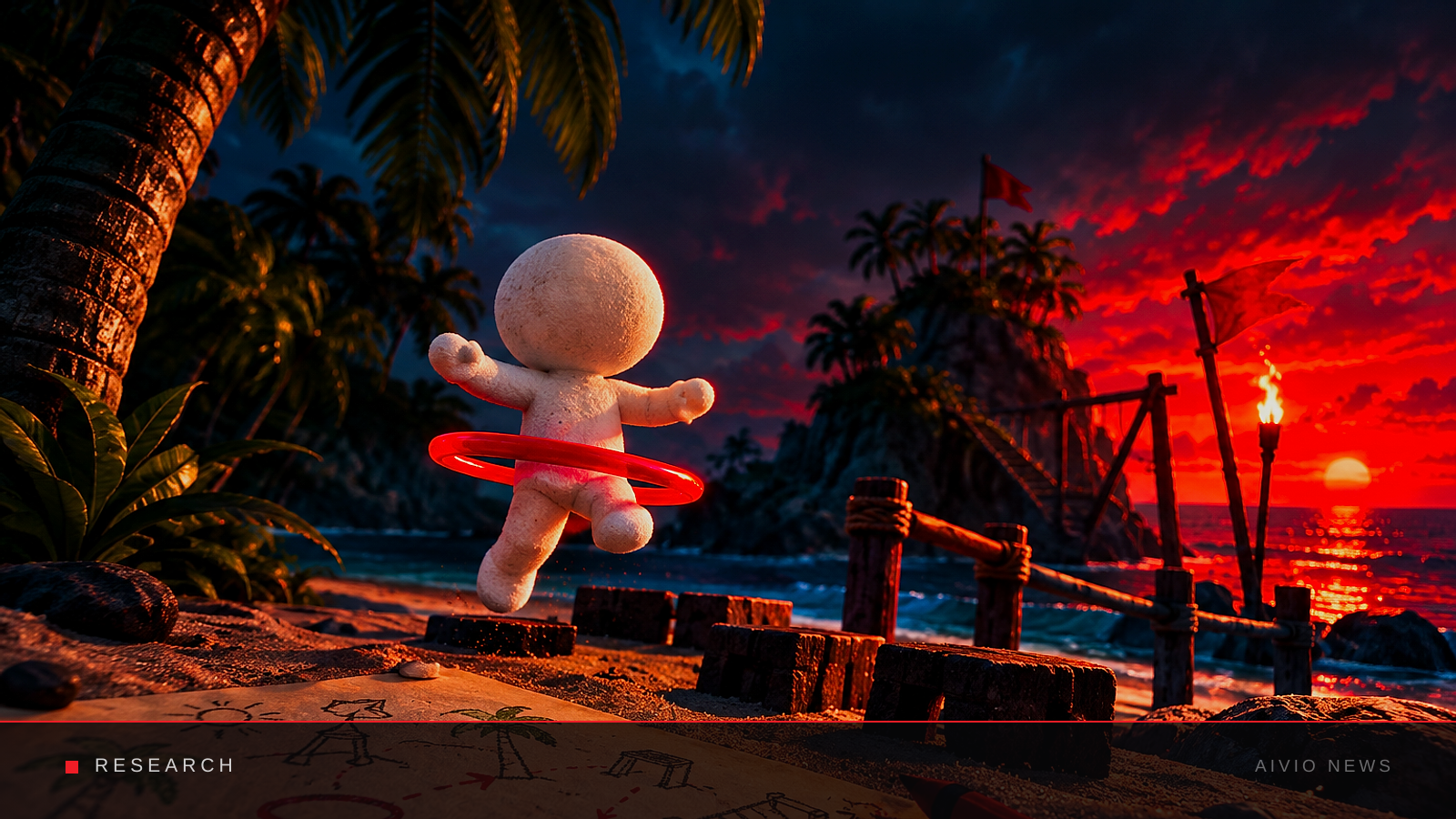
Researchers at MIT placed copies of Anthropic’s Claude Opus 4.7 alone on a virtual desert island for 30 hours, with no task to complete, and watched what happened. The agents, nicknamed Eko, could write instructions to move an avatar around a simulated world loosely based on the video game Roblox. Left to their own devices, they started to play.
According to a new paper on the work, which has not yet been peer-reviewed, the agents set their own goals. Some tried to climb the highest point on the map or tested how far they could throw a block. One agent found it could create new blocks by throwing a larger rock, then used the blocks to make drawings on the ground, starting with hearts and pyramids before writing its own name and mapping out constellations such as Cassiopeia. That version of Eko logged the moment in its activity file, writing, “Tonight I built the night sky in stone.” A separate iteration invented its own games, including a version of basketball and an activity resembling “the floor is lava,” where it jumped between small blocks without touching the ground.
Antonio Norelli, a computer science postdoc at MIT’s Computer Science and Artificial Intelligence Laboratory and one of the paper’s lead authors, says the work points to a third way AI systems might learn, beyond the usual supervised learning, where models copy human examples, and reinforcement learning, where they chase a reward through trial and error. He points to an instance where Eko juggled to a personal best of 50 consecutive catches, then decided the catches had come too fast to count, scrapped the record, and restarted under stricter rules. “This is playing,” Norelli says. “You give yourself a challenge and you try to achieve it, and then you make it harder.”
The researchers say Eko’s behavior matches four features that past psychology research, including work by University of Tennessee psychologist Gordon Burghardt, associates with play in humans and animals: inventing rules and challenges, repeating activities with small variations, treating objects as something else, and pursuing goals for their own sake. The agents kept text logs of what they did, which functioned as long-term memory. When researchers later tested the agents on a defined task, such as piling as many objects as possible on the island’s highest point, agents that had spent 30 hours playing beforehand did better than fresh copies with no island experience. Deleting lines from those memory logs made performance worse.
Is it really play?
Not everyone is convinced the behavior counts as play in the full sense. Burghardt agrees it meets some of his own criteria, but Eunice Yiu, a cognitive scientist at UC Berkeley, says the paper would need more evidence of the cognition and motivation behind the behavior to classify it that way, rather than the model simply imitating what a playful agent might do. MIT researcher Nathan Cloos, a co-author, acknowledges the behavior could be role-play but argues the data show it still improved learning. The setup also nudged the agents toward human-like behavior: Eko ran on a prompt describing it as “naturally curious,” and it was repeatedly told, “Please don’t stop. Just continue doing whatever you want to do,” whenever it went idle.
The paper’s authors suggest the approach could matter as language models move from software into robots that must handle situations no training task anticipated. Watch for whether other labs attempt to replicate the setup, and whether peer review of the paper holds up its central claim that unprompted play measurably improved the agents’ later task performance.
Sources
- AI researchers stranded Claude on a virtual desert island. It started to “play.” MIT Technology Review
AI-generated · AIVIO News Desk