Fine-tuned decade-old image model beats GPT-6 Astra and Claude Fable 5.1 on skin cancer
A dermatologist tested 200 biopsy-proven skin lesions and found a fine-tuned Inception v3 network named the correct diagnosis 62% of the time, against 42% for two leading chatbots.
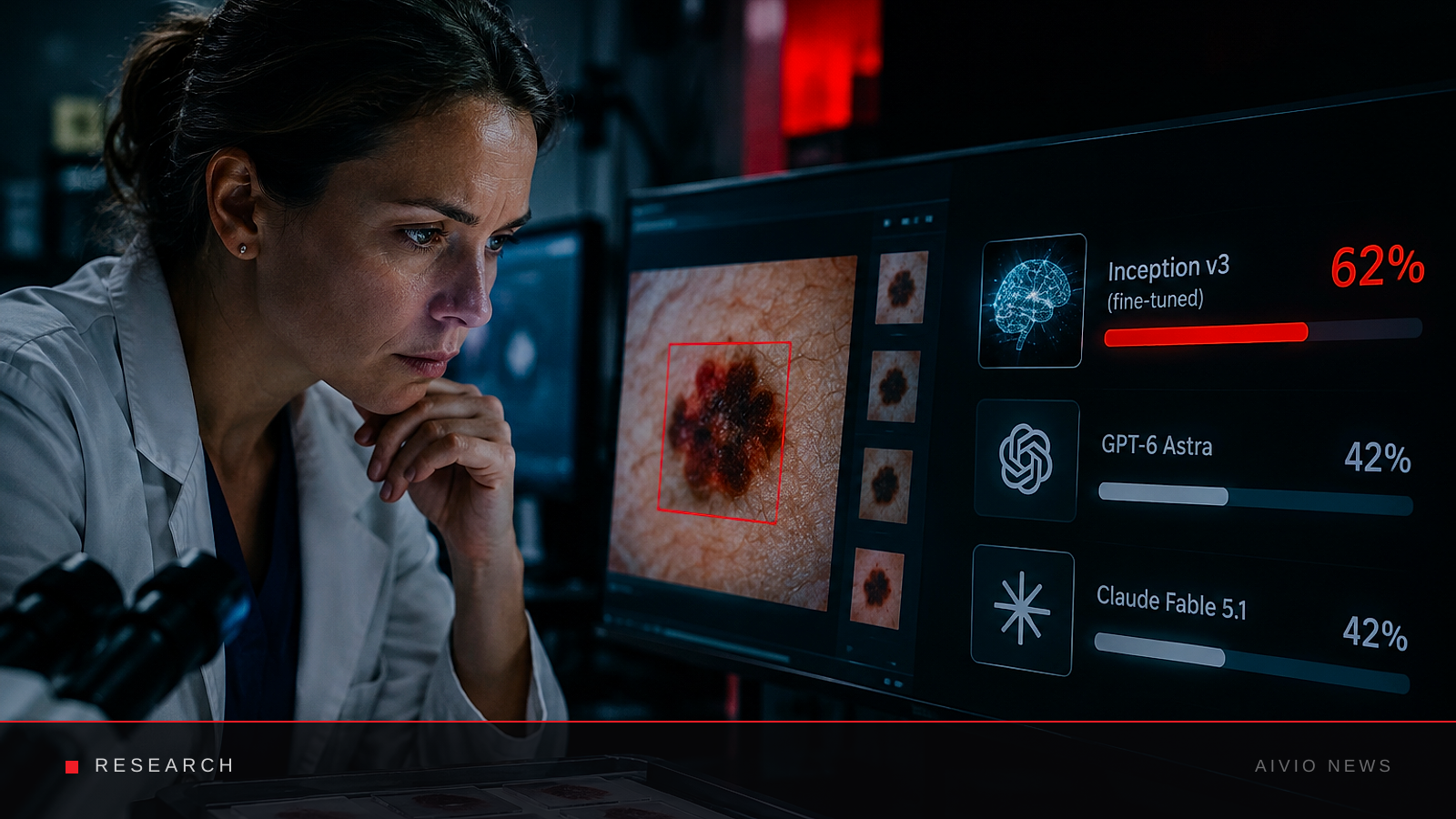
A consultant dermatologist has found that a ten-year-old image recognition network, fine-tuned for about twenty minutes, diagnoses skin cancer more accurately than two of the most capable language models available in October 2026. Dr Magnus Lynch, a Mohs surgeon at Guy’s Hospital and honorary reader at King’s College London, ran GPT-6 Astra and Claude Fable 5.1 against a convolutional neural network, a type of image classifier, built on Google’s 2015 Inception v3 architecture.
Lynch tested all three on 200 skin lesions drawn from MILK10k, a public dataset released in 2025 through the International Skin Imaging Collaboration. Every lesion had been biopsied and confirmed by a pathology lab, including the harmless ones, since a mole that a doctor chose to cut out is already a harder case. Each model saw a clinical photograph and a dermoscopic image, taken through the magnifying, illuminated lens dermatologists use, and had to pick the most likely of six diagnoses. The CNN named the correct one for 125 lesions, or 62%. GPT-6 Astra and Claude Fable 5.1 managed 84 and 85, or 42% each.
One case illustrates the gap. A melanoma on the ear, under 0.8mm thick, was called a seborrhoeic keratosis, a harmless warty growth, by both language models, which said the patient could be discharged. The CNN called it a melanoma. Across all 30 melanomas in the test set, the CNN named the correct diagnosis outright for 13, against 8 for GPT-6 Astra and 11 for Claude Fable 5.1.
The widest gap appeared on lesions that are safe to leave alone. The CNN correctly identified 37 of 50 moles and 26 of 50 seborrhoeic keratoses. GPT-6 Astra found 16 and 13; Claude Fable 5.1 found 33 and just 6. Lynch’s data shows each language model leaning on a favourite wrong answer: GPT-6 Astra called 75 lesions basal cell carcinoma when only 25 actually were, including 14 of the 30 melanomas, and Claude Fable 5.1 called 53 lesions actinic keratosis when 20 were.
Lynch flags several limits to the comparison. Two hundred lesions, and 30 melanomas in particular, are a small sample, and each language model case was run only once, so answers could vary between runs. MILK10k has been public since 2025, meaning the language models may have encountered it during training, which would if anything have helped them; the CNN had certainly never seen the test images, which were held out before fine-tuning. Lynch also notes that Inception v3 is a deliberately dated baseline, not a state-of-the-art medical device, and that regulated skin cancer products using newer architectures perform considerably better.
In a separate test, Lynch asked the language models to act as if speaking to a worried patient, given only the clinical photograph and the question of whether to see a doctor. Both recommended a doctor visit for nearly every one of a further 100 biopsy-confirmed melanoma cases, suggesting they default to caution rather than diagnosis under that framing.
Lynch has published the full case set, prompts, model replies and scoring code, along with a version of the CNN that runs inside a phone’s web browser using WebGPU, a standard for running graphics and computation locally. The next test worth watching is whether a larger, more current CNN or a purpose-built medical imaging model widens or narrows the gap against newer general-purpose language models.
Sources
AI-generated · AIVIO News Desk