GitHub trials HydraFusion, a per-task AI workflow builder in Copilot CLI
The research preview drafts code with one model, escalates to a stronger one when a quality check fails, and bills for every model the workflow calls at standard rates.
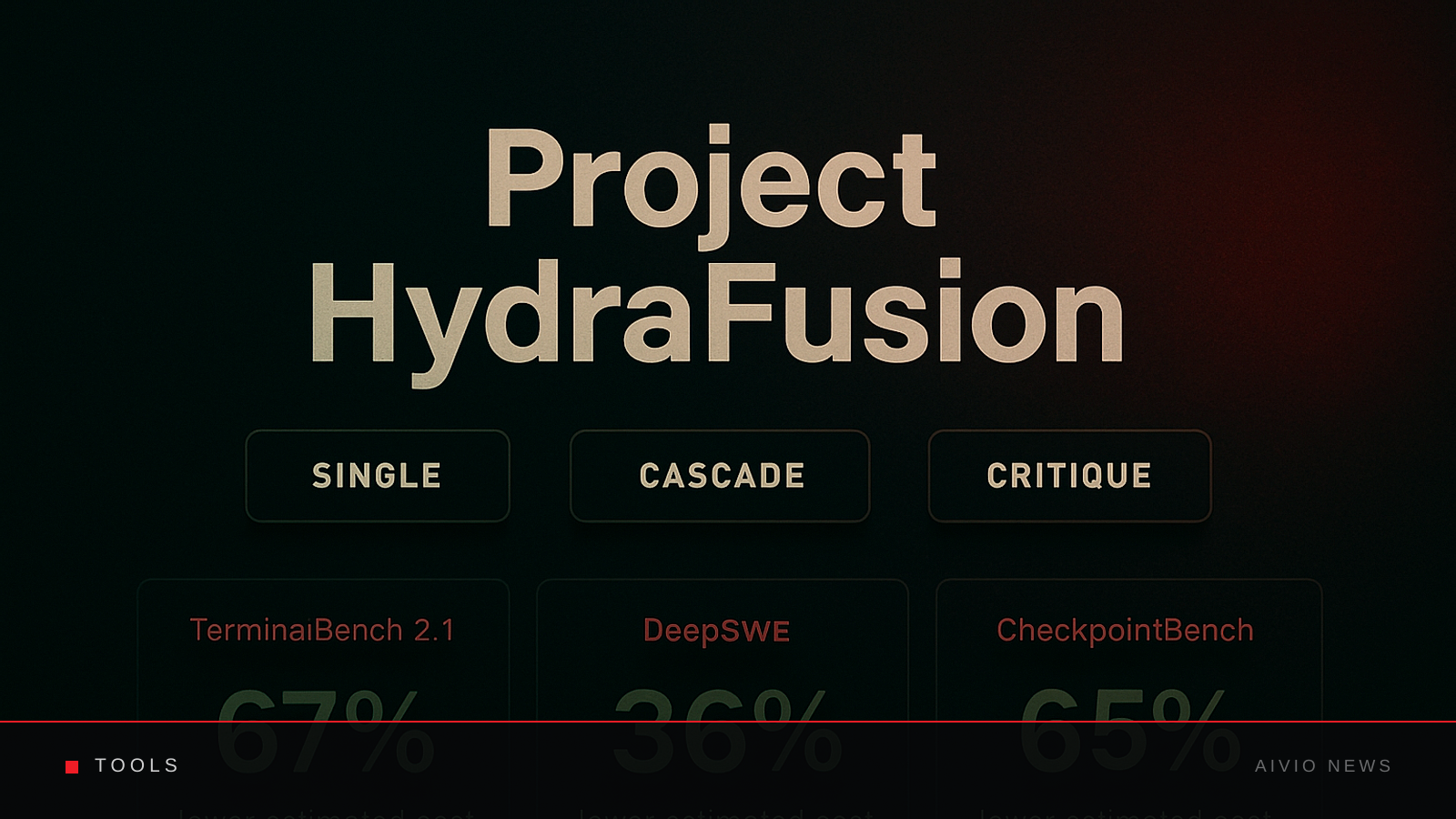
GitHub has released Project HydraFusion, a research preview inside GitHub Copilot CLI that assembles a different execution plan for each coding request instead of sending every prompt to the same model. The system can draft an answer with one model, have a second model check the work, or hand a rejected first attempt to a stronger model, drawing on multiple providers along the way.
HydraFusion currently chooses from three fixed patterns. In Single, one selected model solves the task on its own. In Cascade, a faster and cheaper model drafts a solution, and a quality gate, an automated check that decides whether the output is good enough, either accepts the draft or escalates it to a stronger model. In Critique, one model writes a draft, a separate model from a different provider reviews it without touching the repository, and the original model revises once based on that review.
GitHub says the runtime follows five rules meant to keep repository-level work safe. It accounts for every step, including drafts, critiques, revisions and retries. It enforces a timeout on each step. Critics run in a read-only mode and cannot edit code themselves. No patch is applied if a run fails or is cancelled. Model connections are checked before a task starts. Developers see a single response and one set of proposed changes, even though several models may have worked on it behind the scenes.
Mixed results against Opus 5
GitHub tested fixed versions of the HydraFusion policy on three benchmarks that measure coding-agent performance, comparing them against Claude Opus 5 and GPT-5.6 Sol as baseline models, all set to medium reasoning effort. On TerminalBench 2.1, HydraFusion scored 4.9 points higher than Opus 5 while costing an estimated 67 percent less. On DeepSWE and on CheckpointBench, an internal GitHub benchmark built from real Copilot sessions, it trailed Opus 5 slightly on quality but cut estimated cost by 36 percent and 65 percent respectively.
The feature follows Auto model selection, a simpler tool GitHub shipped earlier in 2026 that matched a single task to a single best-fit model. HydraFusion goes further by treating the choice of workflow itself as something to optimize, aiming for the least complex path likely to clear its quality bar rather than always spending extra model calls. It is available now to users on every Copilot plan, reached by running /update, then /experimental on, then /model and selecting HydraFusion (Research Preview). There are no open weights and no option to run it outside Copilot CLI. Billing is per token, charged at the standard rate of whichever models a given workflow happens to call.
As a research preview, HydraFusion is limited to Copilot CLI and to the three patterns GitHub has published so far. What happens next depends on how GitHub expands that set beyond Single, Cascade and Critique, and whether the mixed benchmark results, gains on TerminalBench 2.1, losses on DeepSWE and CheckpointBench, hold up as more developers route real work through it.
Sources
AI-generated · AIVIO News Desk