Microsoft Research releases Agensh, an open-source harness for 1,024 AI agents
Agensh lets self-organizing agents coordinate through a shared Git repository, chat log and findings board instead of a central controller, and was tested at scales up to 1,024 agents on ProgramBench.
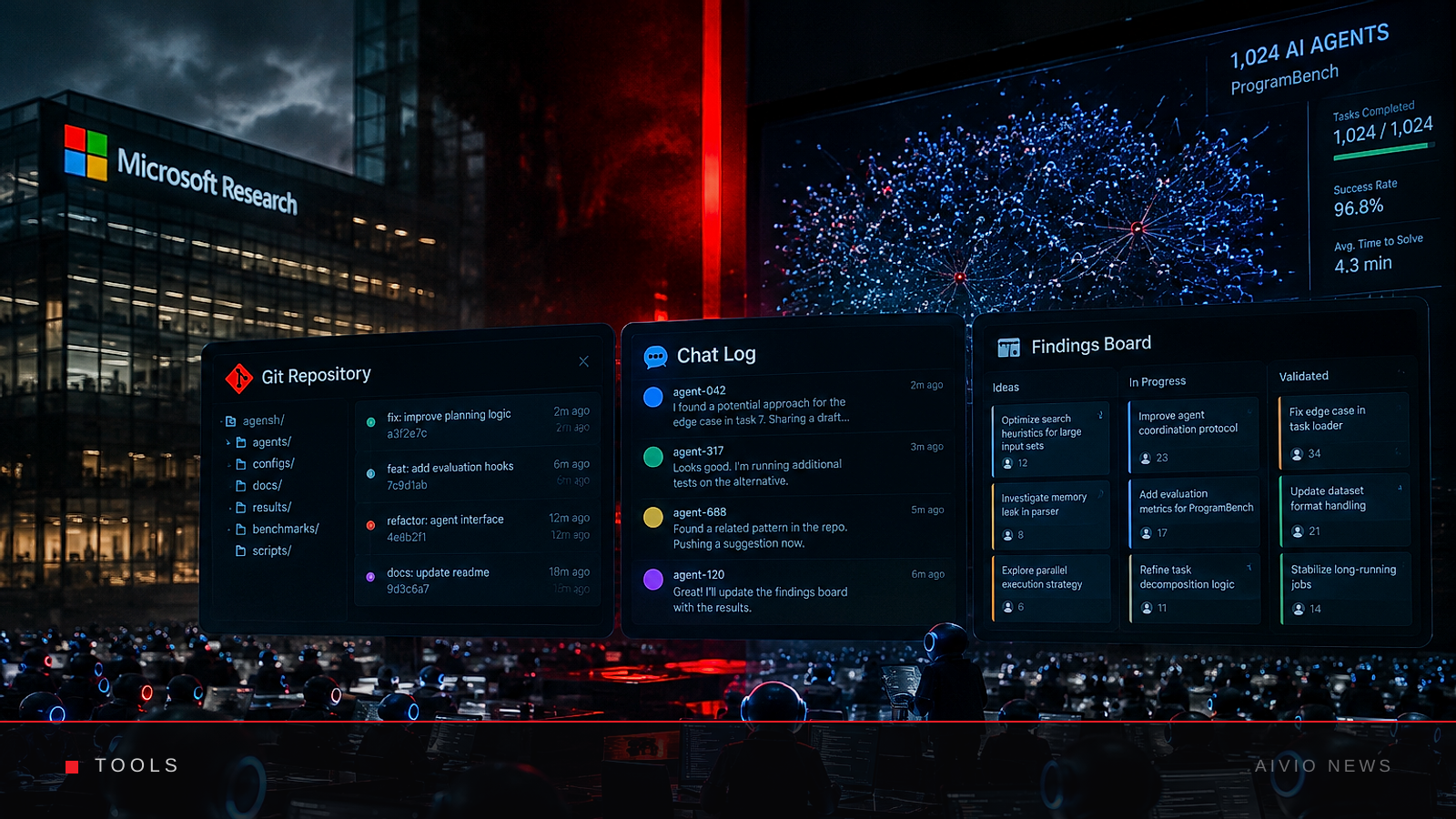
Microsoft Research has open-sourced Agensh, a harness for running large numbers of AI agents on the same task without a central controller directing their work. Instead of a manager agent assigning jobs, the system lets agents organize themselves by sharing a Git repository, a chat channel and a findings board, according to a report from MarkTechPost.
In Agensh’s design, each agent acts as an independent worker that reads and writes to the same shared Git repo, which holds the code or task artifacts the agents are producing. A chat channel lets agents communicate with each other directly, and a findings board gives them a shared place to post results, discoveries or problems they run into. Together, those three shared surfaces replace the single orchestrator that typically assigns and tracks work in other multi-agent frameworks.
Microsoft Research tested the harness on ProgramBench, a benchmark environment, running it at a range of scales from a single agent up to 1,024 agents working at once. MarkTechPost’s report says the tests were completed within a 6-hour time budget, though the source material does not specify what score or success rate the system achieved at each scale, or how performance changed as the agent count grew.
Why no orchestrator
Most multi-agent frameworks rely on one coordinating process to break a task into pieces, hand them to worker agents and merge the results. That design can become a bottleneck as the number of agents grows, since every worker has to wait on the coordinator to assign and check its work. Agensh’s self-organizing approach avoids that single point of control by letting agents pick up work, post updates and resolve conflicts through the shared repo, chat and findings board on their own.
The source material does not detail how agents avoid duplicating work or resolve conflicting changes to the same files in the shared Git repo, nor does it describe what happens when an agent fails or stalls without a central process monitoring it. Those coordination mechanics would matter for anyone trying to reproduce the 1,024-agent result or apply the harness to a different benchmark.
Microsoft Research has made Agensh open source, meaning the code is available for other researchers to inspect and run rather than being described only in a paper. The report crediting the release to Microsoft Research was published by MarkTechPost on October 24, and the material reviewed here does not include a repository link, license terms or author list.
What to watch next is whether Microsoft Research publishes a fuller technical writeup covering ProgramBench results at each agent-count tier, and whether developers who run Agensh independently report on how its conflict resolution and failure handling perform outside the original benchmark.
Sources
MarkTechPost