Kyutai releases REKI, a 2.4B open model for robot manipulation with memory
Built with Inria and École des Ponts and trained only on public data, the model keeps a lightweight memory of its recent actions and is beaten on three difficult tests only by models roughly twice its size.
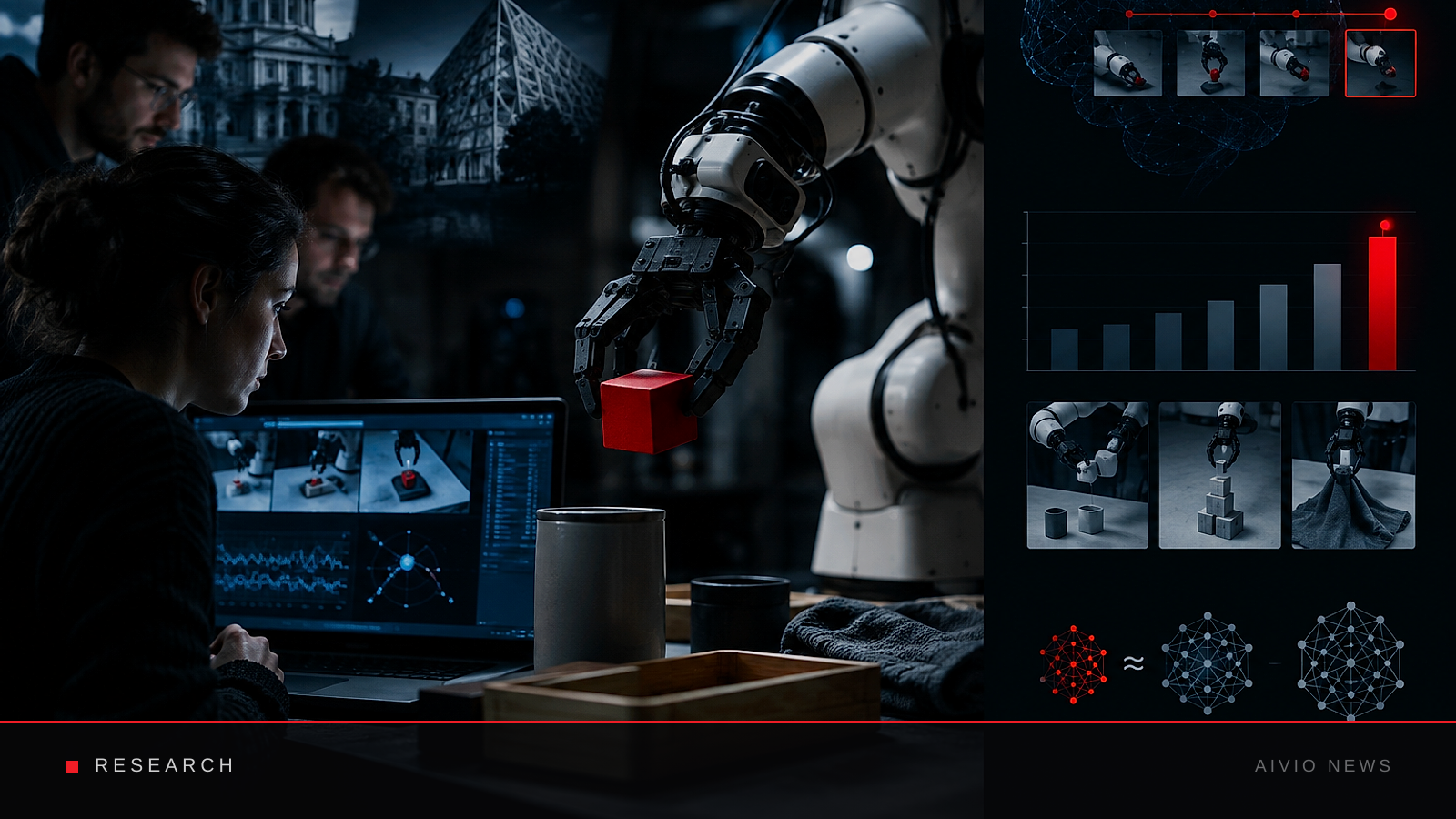
Kyutai, the French AI research lab, has released REKI, a vision-language-action model that reads a camera image and a text instruction and outputs motor commands for a robot. Built with research partners Inria and École des Ponts, REKI has 2.4 billion parameters, a measure of a model’s size and roughly its capacity, and the lab has made all of its weights, the trained numerical values that define the model, publicly available.
Two details separate REKI from many other robotics models. The first is its training data: Kyutai says REKI is pretrained only on public data, rather than on a proprietary dataset collected in-house. That matters for a field where strong results often depend on large, closed robot-demonstration datasets that outside researchers cannot inspect or reuse. A model that reaches competitive performance on public data alone makes it easier for other labs to reproduce the work or build on it.
The second is memory. Kyutai describes REKI as carrying a cheap memory of its recent past, letting the model refer back to what it just did or saw rather than treating every new frame in isolation. The source material does not detail how that memory is implemented or what it costs in compute, so it is not yet clear how this mechanism compares to memory approaches used in other robot models. That is a gap worth tracking as more technical detail becomes available.
How it performs
Kyutai reports that on three out-of-distribution benchmarks, tests that place the robot in conditions different from its training data, only models roughly twice REKI’s size beat it. That is presented as evidence the model punches above its parameter count, though the specific benchmarks, scores and the identities of the larger comparison models are not given in the material reviewed here. Independent verification of those claims has not yet surfaced.
Size matters in robotics models partly because they often need to run on or near the robot itself, where compute and power are limited. A 2.4 billion-parameter model that performs close to models twice as large is, in principle, cheaper to run and easier to deploy than its larger rivals, though actual deployment costs depend on the hardware used and are not addressed in the source material.
Kyutai is already known for open releases in speech and audio models, and REKI extends that approach to robotics. By publishing the weights alongside the claim that training relied only on public data, the lab is positioning REKI as a model other researchers can inspect, retrain or adapt, rather than one whose results have to be taken on faith.
What happens next will depend on whether independent groups can reproduce Kyutai’s benchmark results and on further detail about how the model’s memory component works and what the three out-of-distribution benchmarks actually test. Until then, the size and data claims stand as Kyutai’s own account of the work.
Sources
AI-generated · AIVIO News Desk