OpenAI publishes AI-generated results on three unsolved math and physics problems
The company says its AI models produced findings on the Kakeya conjecture, the Exponential Time Hypothesis and quantum chromodynamics, and is inviting academics to check the work.
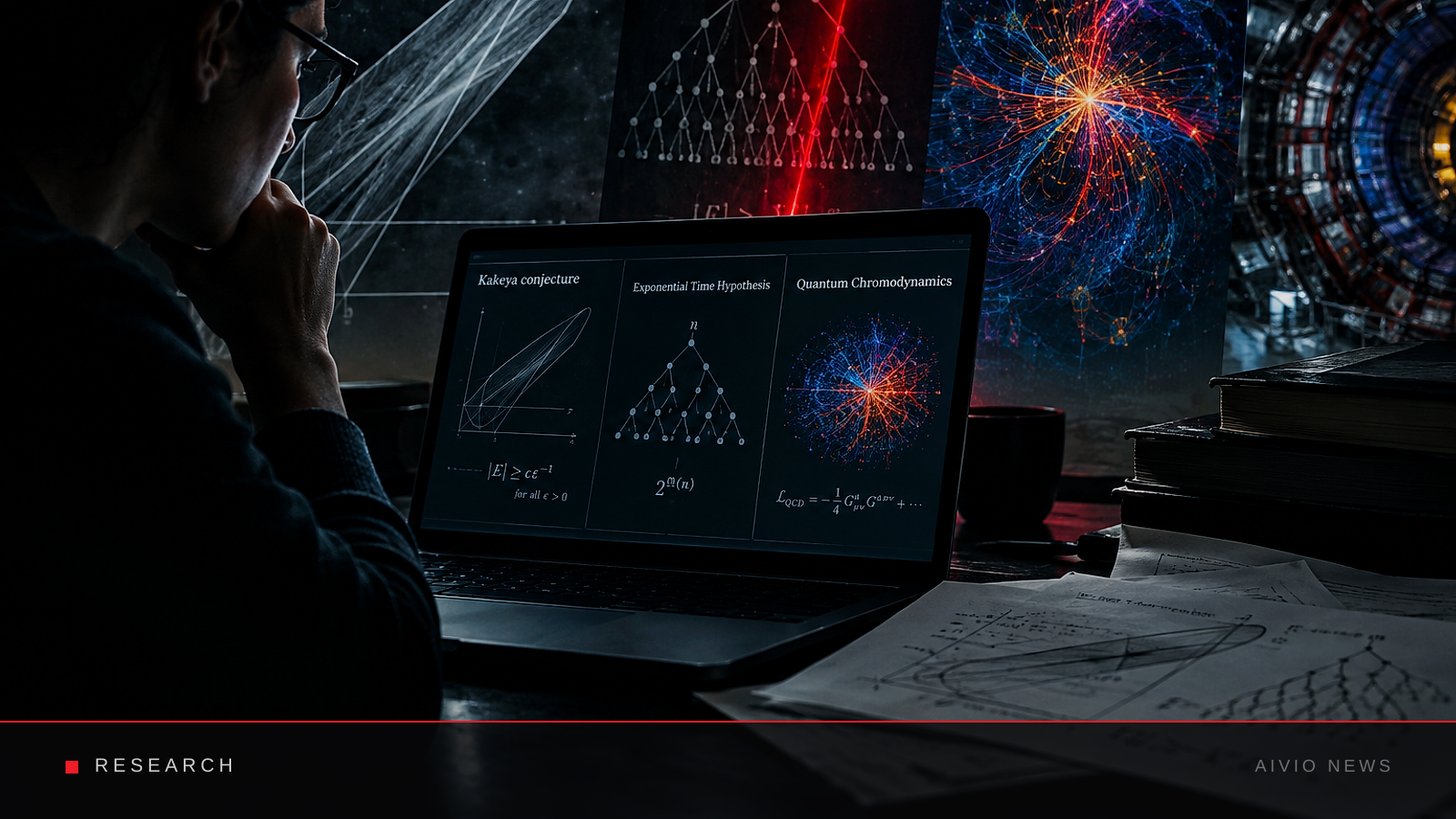
OpenAI has published results it says its AI models produced on three long-standing problems in mathematics, computer science and physics, and has laid out a process for outside researchers to check and extend that work. The company frames the effort as a template for how an AI lab and academic researchers can collaborate on open scientific questions, rather than as a finished solution to any of the problems involved.
The three problems are the Kakeya conjecture, a geometry question about rotating line segments that has stood open for decades; the Exponential Time Hypothesis, a computer science conjecture about the speed limits of certain algorithms; and quantum chromodynamics, the physics theory describing the strong force that binds quarks inside protons and neutrons. OpenAI says it is sharing model results on all three and explaining how researchers in those fields can independently verify them.
Verification is the point
The emphasis, according to OpenAI, is less on claiming a breakthrough and more on making the work checkable. The company says it wants academic mathematicians and physicists to examine the methods and outputs themselves, rather than accept claims about what an AI model found on faith. That framing fits a pattern among AI labs of pointing to hard, well-defined problems from established fields as a way to demonstrate research capability, while leaving the judgment of correctness to the specialists who study those problems for a living.
What is not in OpenAI’s own description is much detail about what, specifically, the models found. The material does not say whether the Kakeya conjecture or the Exponential Time Hypothesis were resolved, partially resolved, or simply explored, nor does it name the model or system used to generate the results, or give a date for when the work was done. Readers should treat “model results” as exactly that: outputs attributed to OpenAI’s own systems, until mathematicians and physicists outside the company have had a chance to check them.
That gap is also why OpenAI’s framing around verification matters more than it might for a typical product announcement. A result in pure mathematics or theoretical physics is not settled by a company blog post; it is settled when peer researchers reproduce or disprove it. By saying it wants to work with academic communities rather than simply announce findings, OpenAI is implicitly acknowledging that its claims need outside scrutiny before they count as established results in any of the three fields.
What to watch next is whether mathematicians working on the Kakeya conjecture, complexity theorists studying the Exponential Time Hypothesis, or physicists in quantum chromodynamics publicly respond to OpenAI’s specific claims by confirming, correcting or rejecting them. Also worth watching is whether other AI labs adopt a similar practice of publishing checkable research outputs on named open problems, which would turn this from a single announcement into the broader pattern of academic-industry collaboration OpenAI says it is aiming for.
Sources
AI-generated · AIVIO News Desk