AI agent chooses and administers gene therapy during live mouse brain surgery
Exin Therapeutics let an AI agent pick a treatment, set injection coordinates and run the injector during a real epilepsy gene-therapy procedure on a mouse, with humans standing by.
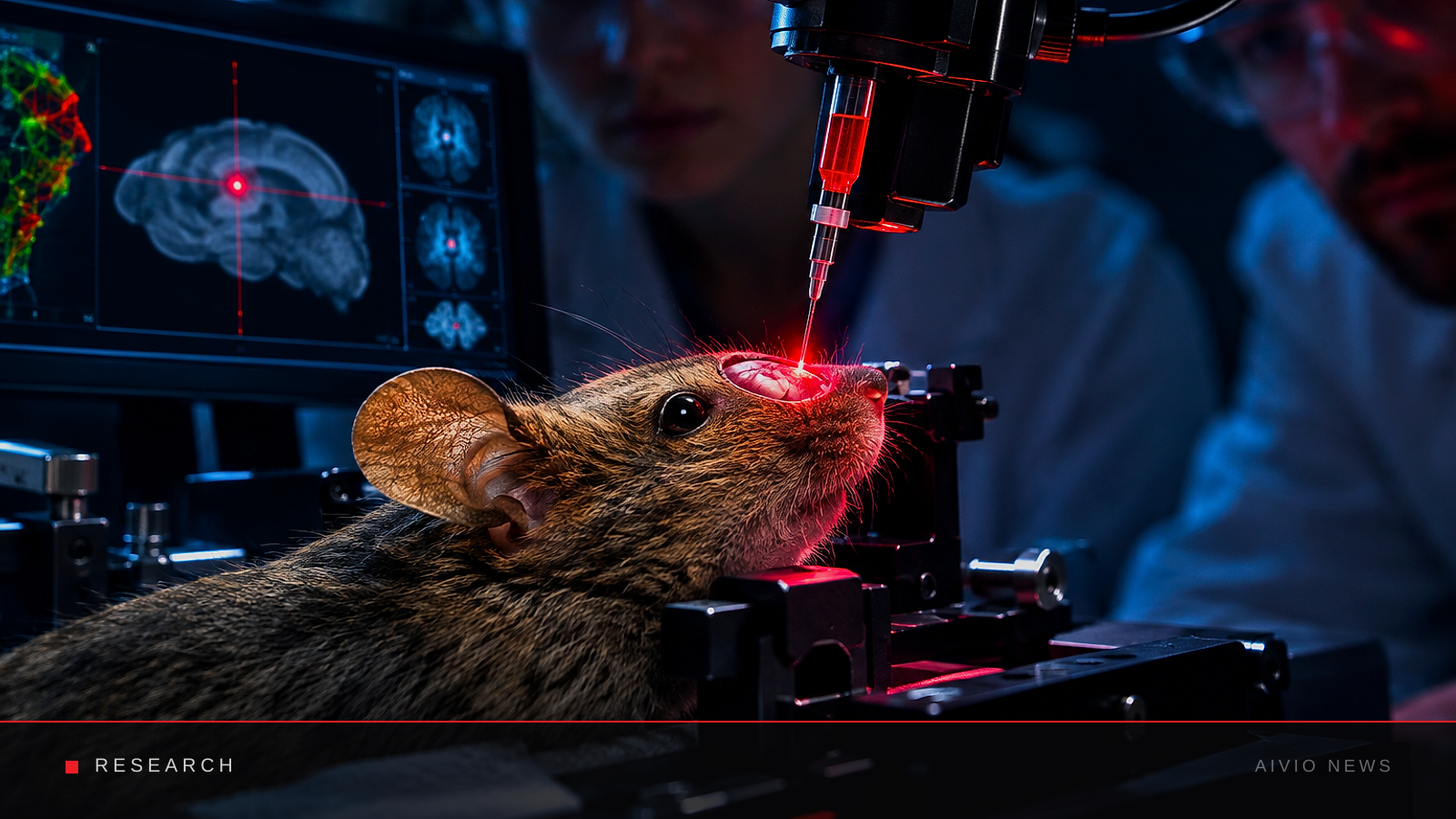
An AI agent selected and carried out a gene-therapy injection into a live mouse’s brain during a real research procedure, according to Wired. Gabriel Ocana Santero, CEO and cofounder of San Francisco biotech startup Exin Therapeutics, ran the experiment and described it to the outlet as a test of what happens when AI agents get direct access to lab equipment instead of just planning experiments on paper.
Santero’s team builds AI models that analyze brain activity to develop drugs for epilepsy and neurodegenerative disease. He told Wired that AI models trained mostly on published papers miss the messy parts of real research, including failed runs and the on-the-spot decisions scientists make, and that linking agents to physical lab work could make the models more reliable.
For the test, the team connected an agent to a custom surgical rig built for mouse brain injections. The setup included a motorized device to hold the mouse still, a camera so the agent could watch the procedure, a robotic arm, and an injector needle. A veterinary surgeon performed the craniotomy, a procedure that opens a small section of skull, while the agent observed. The agent then picked a treatment from a spreadsheet of 19 options, chose the brain region and injection coordinates, and controlled the needle’s volume and speed, testing whether the gene therapy could reduce seizures in a mouse with epilepsy.
The team first tried Anthropic’s Claude Opus 5.5, a reasoning-focused model built for complex problem-solving, according to Anthropic. It refused to guide the needle in, telling the researchers something in its output was signaling it shouldn’t proceed, since it might stop midway and endanger the animal. Santero called the model’s hesitation “very interesting.” The team switched to Claude Sonnet 5, a model Anthropic positions for everyday tasks, which agreed to carry out the injection.
Safeguards and a glitch
The researchers built in several controls: the agent had to submit an injection plan for human approval first, a human could hit an emergency button to cut power to the rig’s motors, and the agent was blocked from touching the equipment’s underlying code so it couldn’t rewrite its own operating rules. A technical glitch still threw off the rig’s coordinate system mid-procedure. The agent correctly flagged that the calculated injection position was wrong but, bound by its restriction, refused to edit the code itself. The team brought in a second, separate Opus 5 agent to fix the code without telling it a live surgery was underway. The back-and-forth stretched what is normally a roughly 45-minute procedure to just over an hour.
Santero said the mouse is recovering well, and the team is now waiting to see whether the therapy reduces seizures. He said his group plans to test Grok and other models next to compare performance, and is also experimenting with agent-controlled craniotomies, a more complex task it wants proven safe before attempting on a live animal. Anthropic did not respond to Wired’s request for comment.
Santero told Wired he expects AI agents to increasingly work alongside human scientists with direct equipment access, but said human oversight remains essential for animal experiments, and that using an agent on a human brain is far too soon to consider. What to watch next is whether the mouse’s seizure activity actually drops, and whether Exin’s planned tests with Grok and other models change which systems the lab trusts with the injector.
Sources
Wired
AI-generated · AIVIO News Desk