Sarvam AI releases Saaras V4 speech-to-text model for all 22 Indian languages
The API-only model pairs a 3-billion-parameter decoder with keyterm prompting and five output modes, and Sarvam says it beats rivals on noisy Indian-language audio.
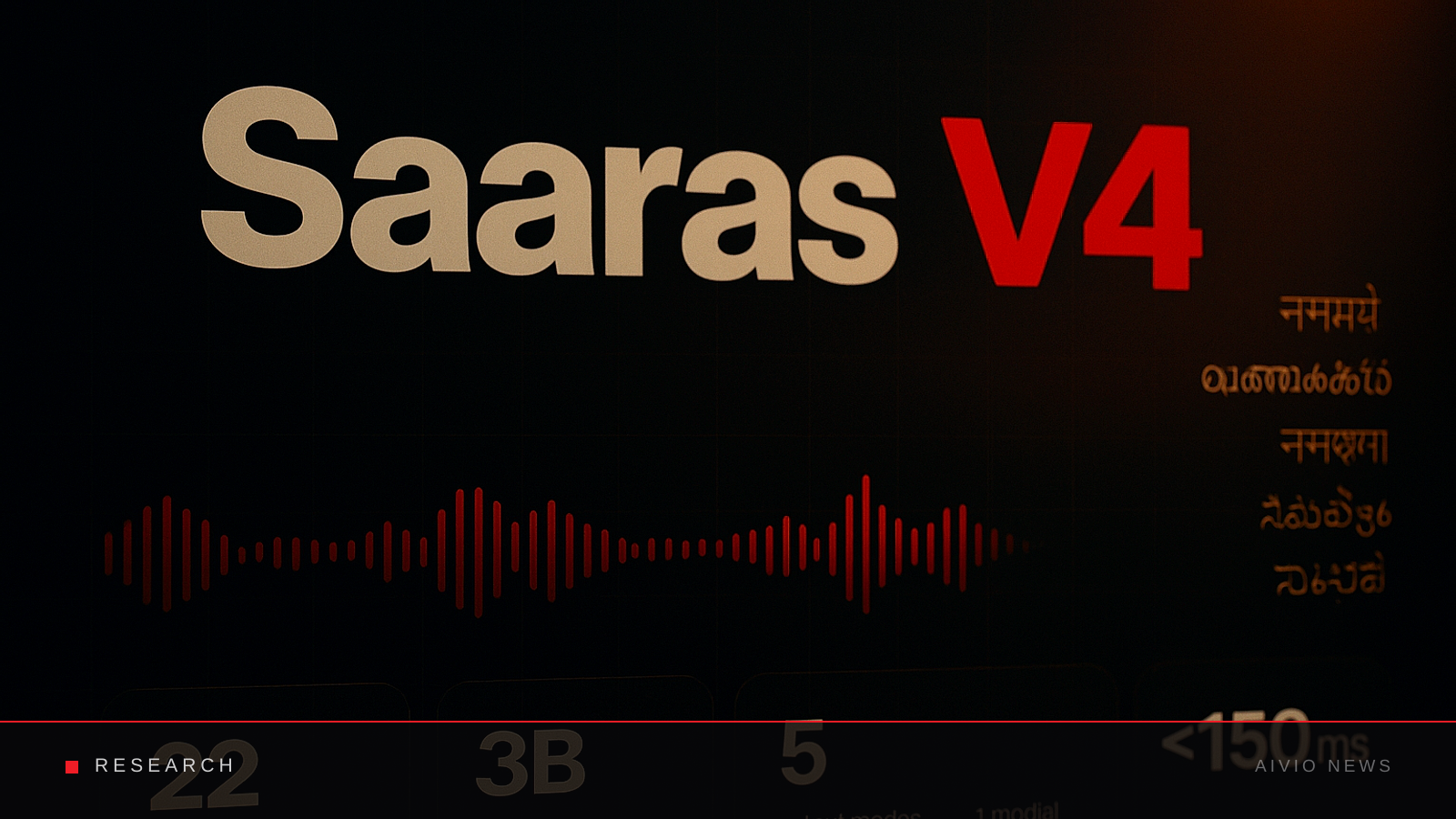
Sarvam AI has released Saaras V4, a speech-to-text model that now covers all 22 of India’s scheduled languages plus English, including global English accents beyond Indian speakers. The model is live today through Sarvam’s API under the identifier “saaras:v4.” Its weights are not public, and Sarvam’s documentation for self-hosting on Amazon SageMaker still covers only the earlier Saaras v3.
Saaras V4 uses an encoder-decoder design. An audio encoder turns the sound wave into embeddings carrying phonetic and acoustic detail. A downsampling adapter then shortens that sequence and maps it into the format the language model expects, keeping long recordings within the decoder’s processing limit. The decoder itself is Sarvam-3B, a 3-billion-parameter hybrid state-space language model, a type of architecture built for handling long sequences efficiently, trained from scratch by Sarvam. It reads the audio features alongside a text prompt and produces the transcript one word at a time.
Sarvam reports state-of-the-art accuracy across all 22 languages, based on its own testing. For English, it measured seven datasets, six from Hugging Face’s Open ASR Leaderboard and one Indian-accented set called Svarah, and says Saaras V4 posted the lowest average error rate among the models it benchmarked. For ten Indian languages in the Vistaar benchmark, Sarvam used both standard word error rate and a semantic variant called LLM-WER, which filters out harmless spelling differences common across Indic scripts. On a noisy version of the Kathbath dataset, containing compressed, clipped and background-heavy recordings, Sarvam says Saaras V4’s error rate came in under half that of Deepgram Nova-3 and OpenAI’s GPT-4o Transcribe. These figures are vendor-reported, and independent reproduction has not been published.
New tools for developers
Saaras V4 adds keyterm prompting, letting developers pass up to 50 specific words or phrases, such as brand names, to bias recognition without guaranteeing they appear in the output. On a benchmark called IndicContextEval, Sarvam reports a 16.03% word error rate in this keyword-prompting setting, which it says is the lowest score recorded there. The model also outputs five representations of the same audio: a default transcript with numbers normalized, a verbatim version with fillers kept, a code-mixed version that leaves brand names in Latin script, a transliterated version, and an English translation.
Sarvam offers the model through WebSocket streaming with a time-to-first-token under 150 milliseconds, a REST endpoint for clips up to 30 seconds, and a batch API for files up to two hours with optional speaker diarization. Pricing is listed at ₹30 per hour for real-time, streaming and batch use, rising to ₹45 per hour with diarization. Saaras v3 remains Sarvam’s default model, and the company says switching to v4 needs only a one-line change to existing API calls.
What remains open is whether outside researchers can reproduce Sarvam’s benchmark numbers, and when, or if, Saaras V4’s weights will be released for self-hosting the way v3’s already are.
Sources
AI-generated · AIVIO News Desk